

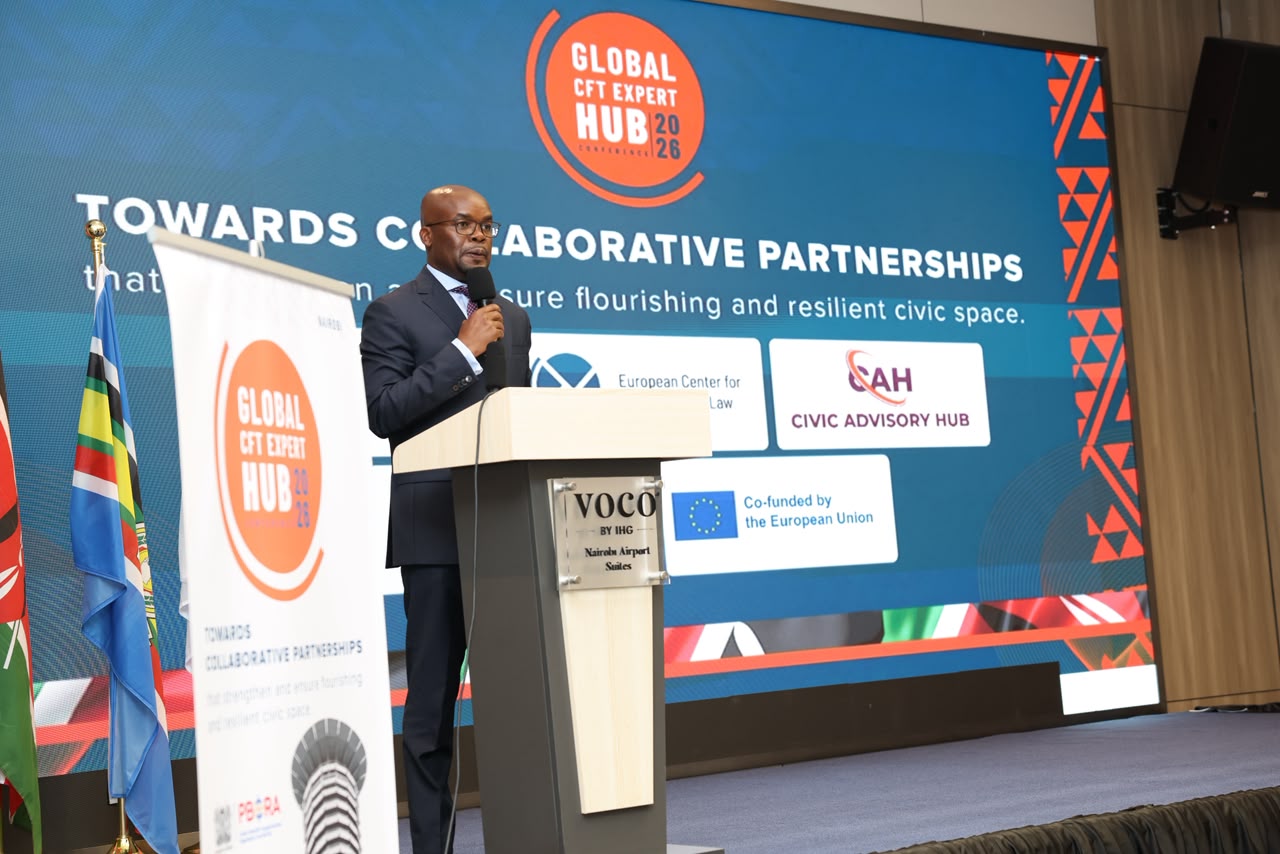
By Amanda Damaris
Kenya has substantially addressed 19 of the 21 action items in its reform plan with the Financial Action Task Force (FATF), placing the country within reach of exiting the global watchdog’s “grey list” of jurisdictions under increased monitoring.
Principal Secretary for Internal Security and National Administration Dr. Raymond Omollo announced the milestone in Nairobi during the Global Counter-Financing of Terrorism (CFT) Expert Hub Conference 2026, noting that the achievements recorded as of October 2026 represent more than 90 per cent of the country’s reform obligations.
“As of October 2026, we had substantially addressed 19 of the 21 action items under our national International Cooperation Review Group (ICRG) Action Plan. This progress demonstrates our commitment to addressing identified vulnerabilities, strengthening institutional capacity and aligning our systems with international standards,” Dr. Omollo told the three-day gathering, which brought together more than 150 delegates from governments, financial institutions, civil society, and multilateral bodies.
Road to Removal
Kenya was placed under increased monitoring following a high-level political commitment made in February 2024 to work with FATF and the Eastern and Southern Africa Anti-Money Laundering Group (ESAAMLG) to seal loopholes in combating money laundering, terrorist financing, and the financing of weapons of mass destruction.
Since then, Nairobi has overhauled risk-based supervision for financial institutions and designated non-financial businesses and professions, improved the filing of suspicious transaction reports, designated a regulator for trusts, and tightened the collection of beneficial ownership data. Authorities have also aligned targeted financial sanctions with FATF Recommendation 6 and upgraded the quality of financial intelligence products.
Under FATF procedures, a country must complete all or nearly all components of its tailored ICRG Action Plan before undergoing an on-site verification visit. A successful assessment clears the path for formal removal from public monitoring at the subsequent FATF plenary.
Protecting Civic Space and Combating ‘De-Risking’
A central pillar of the reforms is ensuring that counter-terrorist financing rules do not choke legitimate charity and community work. Dr. Omollo stressed that regulatory oversight must be proportionate and grounded in data rather than blanket suspicion.
To illustrate this evidence-based shift, the Principal Secretary cited a recent risk assessment of 260 faith-based organisations operating in nine high-exposure counties. The study found that 76.2 per cent posed a Medium-Low Risk and 13.8 per cent were Low Risk, while 5 per cent fell into the Medium Risk category. Only 3.8 per cent were classified as Medium-High Risk and 1.2 per cent as High Risk.

Under the new differentiated framework, only the 5 per cent in the High and Medium-High Risk brackets face enhanced on-site inspections and mandatory annual CFT returns, while the remaining 95 per cent undergo routine desktop reviews. The government has also removed non-profit organisations from mandatory reporting entity lists and designated the Public Benefit Organizations Regulatory Authority (PBORA) as the sector supervisor, supported by a dedicated oversight division.
Dr. Omollo further urged banks to abandon wholesale “de-risking”—the practice of denying financial services to entire categories of non-profits over perceived risks.
“Our approach is clear: risk management should not become risk avoidance. We must manage risks intelligently without restricting legitimate humanitarian, faith-based, development and community activities,” he said.
Regional and UN Backing
PBORA Director General Dr. Laxmana Kiptoo echoed the call for measured oversight, noting that the operationalisation of the Public Benefit Organizations Act and the PBO Regulations of 2026 has strengthened sector transparency without imposing blanket restrictions. “The fight against terrorist financing must strengthen, not undermine, the legitimate work of organisations that serve humanity,” Dr. Kiptoo said.
Representing the ESAAMLG Executive Secretary, Christopher Likomwa acknowledged that terrorist networks have previously exploited some non-profits to move funds, but warned governments against over-applying FATF Recommendation 8 in ways that stifle civic activity. With the region undergoing its third round of mutual evaluations, he said collaboration between regulators, banks, and NGOs remains vital.
Meanwhile, Kodjo Attisso, Coordinator of the Illicit Finance Fusion Center – Africa at the United Nations Office on Drugs and Crime (UNODC-ROEA), urged states to look beyond technical compliance and measure real-world effectiveness. Emphasising financial inclusion, evidence-based risk profiling, and institutional trust, Attisso affirmed UNODC’s continued technical and analytical support to regional governments and civil society.
