

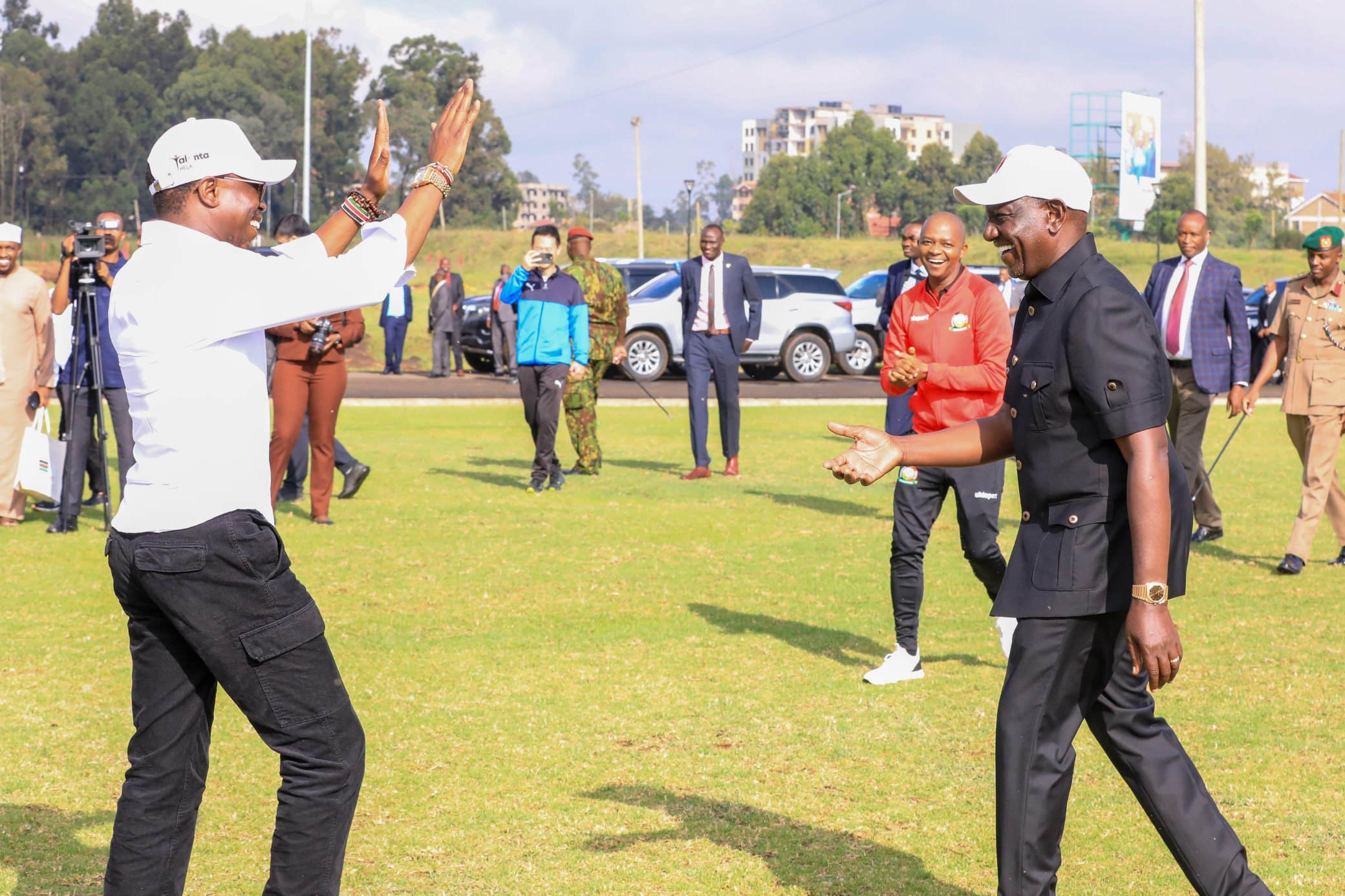
Former Sports Cabinet Minister Ababu Namwamba speaks with the quiet assurance of a strategist whose once-audacious gamble has paid off in full view of a continent. Click this link https://a.meridianbet.ke/c/C7pYjz to start gaming and stand a chance of winning big with Meridianbet.
Now serving as Kenya’s High Commissioner to Uganda, Namwamba finds himself at the geopolitical epicenter of the very region he helped unite through sport. Yet, behind his current diplomatic docket lies a monumental legacy carved during his tenure as Kenya’s Cabinet Secretary for Youth Affairs, Sports, and the Arts—a legacy marked by two historic victories: bringing the 2027 Africa Cup of Nations (AFCON) to East Africa under the joint Pamoja Bid and landing the 2029 World Athletics Championships on African soil for the first time in history.
“When I was being asked to move into diplomacy, I must thank the President that he gave me the free hand to choose which capital to serve as ambassador, and I had no hesitation in picking Kampala,” Namwamba says, reflection softening his gaze. “I thank Uganda because I have felt at home from day one, from the moment I arrived in Kampala. Today I look back and say it was worth every single energy, every single ounce of effort that we put in was worth it.”
It is a striking contrast to the bleak landscape Namwamba inherited when he walked into the Sports Ministry on October 27, 2022.
A CRISIS OF FAITH AND THE SKEPTICISM OF A NATION
When Namwamba assumed office, Kenyan sports was in complete disarray. The country was isolated, grounded, and facing total systemic collapse.
“I took office on October 27, 2022. And at that time, Kenya was banned from international football,” Namwamba recalls. “At that time, the sword of a ban from World Athletics for doping was hanging on Kenya’s neck. If the ban had not been lifted at the time it was, it would not have been conceivable to even start thinking about bidding for anything. How would you bid for something which you are not playing?”
Concurrently, a dusty file sat on his desk outlining Kenya’s failed bid to host the 2025 World Athletics Championships—a bid lost to Tokyo. “Looking at that bid, there were serious issues around infrastructure,” he explains. “Number two, the issue of doping, which has dogged Kenya for a while, had not been properly addressed. So I told Athletics Kenya, ‘Let 2025 go, prepare to go to Tokyo to attend the World Athletics Championships, pick lessons… then let’s sit down and put in a solid bid for 2029.'”
In January 2023, World Athletics President Lord Sebastian Coe landed in Nairobi, demanding decisive action. “Among the agenda was a serious concern about doping,” Namwamba notes. “I had to put a plan I announced with 600 million Kenya shillings to go to war against doping.”
The war against doping and the rehabilitation of critical sporting infrastructure became the cornerstone of a grander vision. Yet, convincing a battle-weary Kenyan public proved to be as daunting as convincing international sports federations.
“When I was expressing these ideas to the public, there was a lot of skepticism… because Kenyans had seen too many disappointments before,” Namwamba says candidly. “There was a lot of skepticism, there was a lot of negative energy in the air and everybody was like, ‘Oh really, is it really worth the effort? We have tried it before, it has not worked.'”
For decades, Kenya had suffered the embarrassment of lost opportunities. The country was granted the rights to host AFCON 1996, only to withdraw due to unpreparedness—handing the event to South Africa. A similar failure occurred with the 2018 African Nations Championship (CHAN).
“We had settled, had become too comfortable with mediocrity, and we had come to accept low standards,” Namwamba reflects, his voice firming. “We would construct a stadium like Kirigiti and comfortably brand it Kirigiti International Stadium, and be happy that it is an international stadium. When you go to the facility, the only international thing about it is the name International. Other than the name International, there was absolutely nothing international about it. Anytime I talked about a modern new stadium, Kenyans would show me the images of Amahoro.”
Namwamba knew that incremental changes would fail. What was required was a cultural revolution.
BURNING THE BOX: THE BIRTH OF THE PAMOJA BID
Namwamba went to work, helping design the sports and creative economy roadmap under the Kenya Kwanza administration. “I had actually participated in writing that plan, and when you go to that plan, you find a very clear agenda on how to deploy sports and the creative economy to propel our economic development. Among the targets in the plan was to make Kenya a hub for hosting significant regional and international events.”
When the idea of hosting AFCON was initially floated, the default instinct within government circles was for Kenya to bid alone. Namwamba pushed back.
“I proposed that instead of Kenya going it alone, why don’t we do a Pamoja bid?” he says. “I’m very Afrocentric, I’m very Pan-African in my thinking, I’m very pro-integration. I see integration as the panacea for a lot of the challenges that face various countries in the East African Community block… for us to really unleash our full potential, doing things together is always better than doing things separately.”
He saw a rare opportunity to use sports diplomacy to re-ignite regional integration. “I saw an opportunity to add momentum to the whole integration journey, because our integration effort in East Africa has stalled a little bit,” he says. “When we looked at our ability to put all the infrastructure together in three to four years, we thought it might be more cost-effective and more compelling for CAF if we went as a team.”
The idea gathered momentum through swift diplomatic engagement. “We consulted with friends in Uganda, my friend Peter Ogwang, the State Minister for Sports in Uganda, and Mr. Magogo, the President of FUFA. We consulted with our friends in Tanzania, we also consulted with our friends in Rwanda… Uganda came on board right away, they thought it was a brilliant idea. Tanzania came on board, they thought it was a brilliant idea.”
Back home, he presented the ambitious strategy to the Head of State. “I then escalated the idea to His Excellency President William Ruto, and he loved the idea… He made me go over the plan quite a bit with him to explain to him how it would work. I had to prepare a very comprehensive plan for President Ruto. I prepared a cabinet memo, a very comprehensive cabinet memo that I presented to my colleagues in Cabinet, which laid out that whole framework. And right away, I thought AFCON 2027 was a good starting point.”
The strategy was anchored on three pillar objectives: revolutionizing infrastructure, building a talent pipeline, and marketing the region. “Reason why we lost ’96 AFCON and 2018 CHAN was to a very large extent due to unpreparedness with regard to infrastructure,” he stresses. “Target number two was to invest in a talent pipeline. It’s so good to host events, but it is not so pleasant to host events where you are walloped left, right, center… so I was convinced that even as we plan to host events, we must also plan to develop talents. The whole idea behind the Talanta Hela initiative… when you saw the very deliberate investment in youngsters like Aldrine Kibet, like Amos Wanjala, and that whole host of young talent, it was part of that agenda.”
THE NIGHT IN CAIRO AND THE DIPLOMATIC GAMBIT
Despite the internal alignment, the East African bid faced fierce external opposition when it landed on CAF’s desk. Heavyweights like Algeria and formidable bids from West Africa were competing for the same hosting rights.
“Now, when we went to convince CAF, remember we had strong competition,” Namwamba recalls. “We had competition from Algeria, we had very strong competition from West Africa… There was a side issue, which became primary, was to convince CAF that indeed Kenya had turned the corner and that we were now playing by different rules. CAF was used to Kenya promising things which they don’t deliver. So, we also had to convince CAF this is a new administration. I used to say there’s a new sheriff in town.”
The tension reached a boiling point on the eve of the final vote in Cairo.
“I do recall when I arrived in Cairo… I had been on an international assignment in the US at the UN General Assembly. So I flew straight from Orlando to Cairo to attend the CAF Congress where the decision was being made. I found our team was not in very good spirits. They thought… I think we are losing this bid.”
What followed was an intense, all-night lobbying campaign. “We did a lot of lobbying the whole night. We literally did not sleep the whole night… In the morning, we got together, the three ministers, the three of us—myself, my friend Peter, and our Tanzanian colleague—we walked into that hall with a joint message, a compelling message.”
During the final presentation to CAF President Patrice Motsepe and the Executive Committee, Namwamba pulled out his secret weapon—a physical symbol of East African unity.
“And the people of East Africa might want to know that one of the turning points in the convincing game, I had carried the East African passport,” he reveals. “So, I waved that passport in that room to Motsepe and the whole team, and I asked them, ‘Tell me whether there is any region on this continent that boasts of a passport with regional reach. A passport available… eight countries: Kenya, Uganda, Tanzania, Rwanda, Burundi, South Sudan, Somalia, and now DRC Congo.'”
He mapped out a seamless tournament experience for fans: “Travel to Dar es Salaam, Kampala, Hoima, Nairobi without having to take multiple visa for each country… so that if you are coming from Egypt, or you’re coming from South Africa, you’re coming from Cameroon, even coming in from Paris, and you are coming to watch AFCON, you should have a single-entry visa.”
He reminded the committee of the sheer geography of African football equity: “You cannot have a tournament that is dominated by a few regions… when you talk about the East African Community region, AFCON has never been here. Then they realized this is not just about Kenya, or Uganda, or Tanzania. It’s actually about a whole region of Africa of eight countries with 400 million people who are football crazy.”
The argument proved irresistible. CAF awarded AFCON 2027 to the East Africa Pamoja Bid.
A BLUEPRINT IN CONCRETE: TALANTA CITY AND THE 2029 WORLD CHAMPIONSHIPS
With the AFCON bid secured, Namwamba turned his master plan into tangible steel and concrete. He drafted a comprehensive Infrastructure Improvement Master Plan that set strict standards for stadium upgrades.
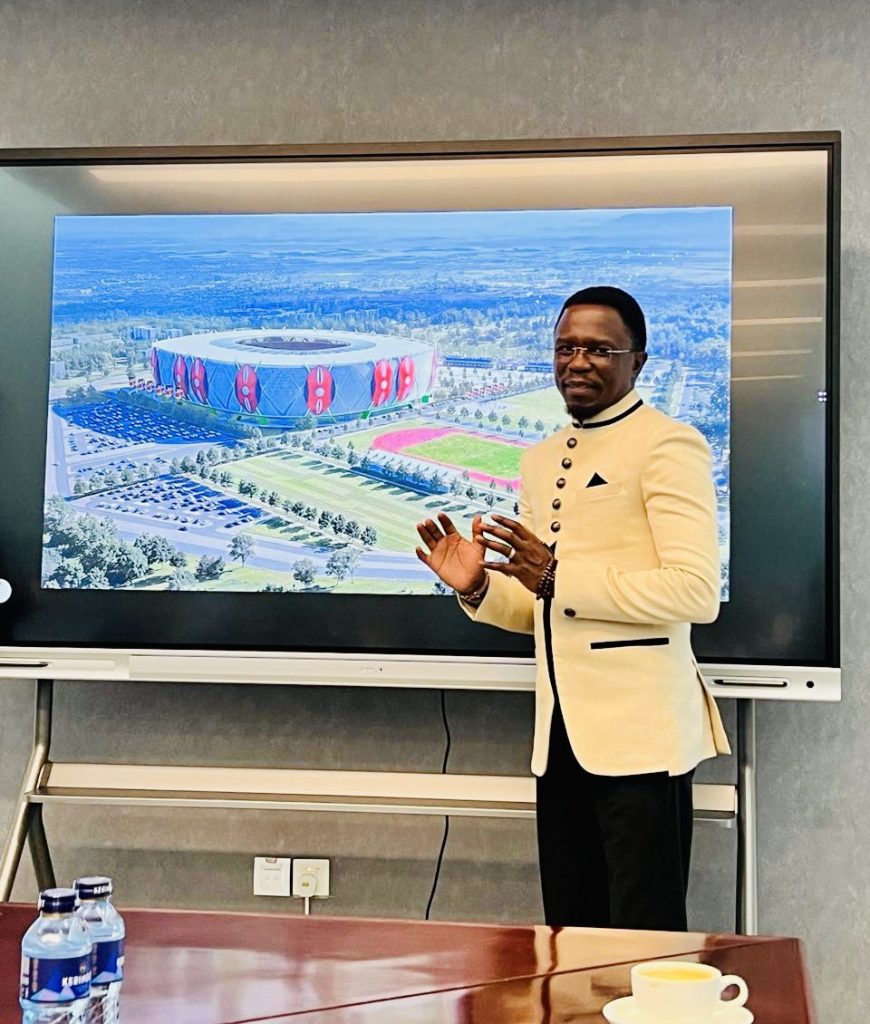
“This master plan set targets in terms of what would qualify to be an upgrade of Kasarani for instance,” he notes. “I convinced Cabinet that we need a spanking new modern state of the art stadium… a stadium that would really not be Kirigiti or Mambo Leo. No. A stadium that can stand side by side with modern stadia.”
Today, the transformation is underway across Nairobi. “Today you can see the fruits. You can see the spanking new Kasarani by Kasarani Road… by, by Thika Road. Kasarani is looking, is looking improved. Nyayo has been improved, and above all, Talanta, the jewel in the crown.”
For Talanta Sports City, Namwamba personally intervened in the architectural concept to ensure it carried an unmistakable national identity.
“The good thing we did with Talanta is that in the plan, I was very deliberate in the design of Talanta because I sat down with the designers, I had a very clear idea in my mind,” he shares. “Even those big shields you see, those were my… those were my additions to the project… just to… to Kenyanize the project. We put in technology, whether you’re talking about… you want to do VAR, or you want to do goal line technology… all those things we infused them into the infrastructure of the stadium.”
Namwamba’s vision extended to modern urban transit integration: “We had a plan… part of the grand plan for Talanta Stadium was to extend a light rail service from the CBD. You’d have a light rail service from the CBD via Nyayo to the new Bomas facility… and then through Ngong Forest to… Talanta Stadium. That rail service, which rail plan must happen. Because the Ngong Road corridor is very narrow…”
This relentless drive on infrastructure and anti-doping laid the foundation for the next historic milestone: World Athletics awarding the 2029 World Athletics Championships to Nairobi.
“I am such a proud Kenyan. I mean, when I heard that announcement, I was like, ‘Oh my god, this is it! We’ve done it!'” Namwamba says, reflecting on the confirmation. “This is the pinnacle of world athletics, and it’s coming to Kenya, to Africa for the first time. Africa really should celebrate this because this will be a shot in the arm for athletics, not just for Kenya, but for this region that is such a phenomenal part of world athletics… You cannot deny the fact that Kenya is an athletics powerhouse.”
DELIVERY AND THE CONTINUING DIPLOMATIC MISSION
Now stationed in Kampala, Namwamba continues to nurture the partnership he helped build, maintaining daily communication with his Ugandan counterparts.
“I consult with Uganda’s Minister of Sports Peter Ogwang pretty much every other day. I consult with the President of FUFA every other day…” he says. “AFCON is now in East Africa, and the people of East Africa can look forward to a phenomenal extravaganza of African football.”
Yet, as someone who navigated the turbulent journey from initial skepticism to final victory, his parting words carry an urgent caution for the Local Organizing Committees (LOC) charged with hosting CHAN and AFCON 2027.
“Winning the bid for me is actually a quarter of the game… The real game is delivery,” Namwamba warns. “After you have won the bid, you must deliver a phenomenal, memorable event. The LOC is to deliver. And you will deliver well if you pay attention to those… what may appear to be minor, those details that may appear to be minor. As the LOC, keep your eye on the ball… with surgical precision. Attention to detail—every little detail must not escape you as the LOC.”
Looking out over Kampala, Ambassador Ababu Namwamba smiles—a man who refused to accept low standards, burned the box of conventional thinking, and successfully placed East Africa at the center of the global sporting map. “My plan has worked,” he concludes quietly. “There were so many doubting Thomases then… but Kenyans have now seen that it’s possible to plan something and actually deliver it.”
